 Penn & Hazel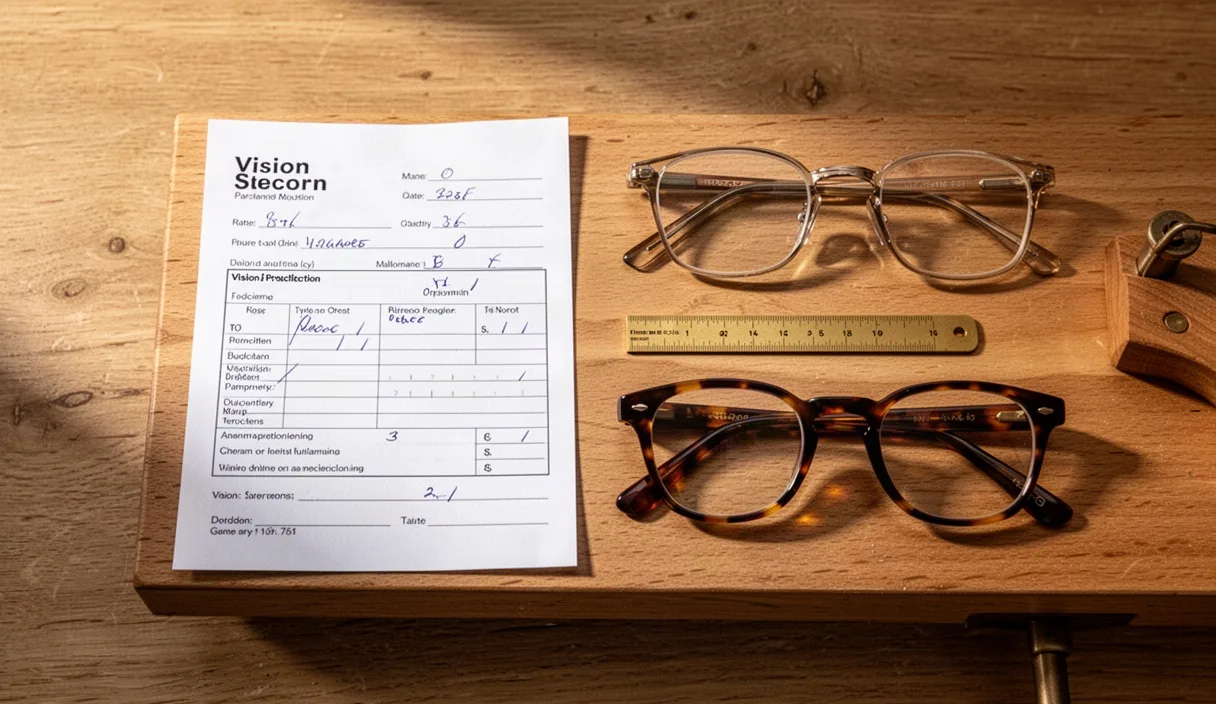
When you sit down with your paper slip after an eye exam, the rows of letters and numbers can look like code. We see this look of confusion in our shop all the time, and we promise it is much simpler than it appears. Once you know what each abbreviation stands for, your prescription tells a clear story about how your eyes focus light.
Understanding Sphere, Cylinder, and Axis
The first three values on your slip describe the shape of your correction. Sphere, noted as SPH, tells you how strong your lens needs to be to correct nearsightedness or farsightedness. A minus sign like -2.25 means you have trouble seeing street signs in the distance, while a plus sign like +1.75 means nearby print looks blurry. These numbers measure diopters, which grow in steps of 0.25. Next comes the Cylinder, or CYL, which shows the correction for astigmatism. If your cornea curves more like an oval football than a round basketball, this number balances the focus. Right beside it, you will spot the Axis, written as a whole number between 1 and 180 degrees. The axis simply tells our lens grinder where on the lens to place that astigmatism correction.
What Pupillary Distance Means for Frame Fit
Another vital measurement is your pupillary distance, often shortened to PD. This is the exact distance between the centers of your two pupils, measured in millimeters. An adult measurement usually falls somewhere between 58 and 68 millimeters. While your doctor's other numbers dictate the curve of the glass, the pupillary distance tells us where the optical center of the lens must sit inside your chosen frame. If a lens sits even three millimeters off from your pupil center, you might notice eye strain, slight nausea, or mild headaches by late afternoon. Your doctor or optician can measure this quickly with a digital gauge or a millimeter ruler during your visit.
If you are past forty, you might also see a number under the ADD box. This reading addition indicates extra magnifying power, usually between +0.75 and +2.50, layered onto your distance prescription to help you read books and phone screens comfortably. To make sense of your paper before ordering, follow this quick review:
- Check the eye label: OD refers to your right eye, while OS refers to your left eye.
- Review your distance values: note whether your sphere starts with a plus or minus symbol.
- Confirm your add power: verify if you need single-vision lenses or multifocal options like progressives.
Prescriptions do not stay accurate forever. Most paper slips expire after one or two years, depending on regional rules and your doctor's recommendations. You should consider booking a fresh exam if you catch yourself squinting at road signs, holding menus at arm's length, or dealing with frequent afternoon fatigue. Eyeglass numbers cannot diagnose underlying eye health, so regular checkups with a licensed optometrist or ophthalmologist remain essential. When you have your latest slip in hand, bring it by the shop or send us a copy, and we will gladly help you pick the right frames and lenses for your daily routine.